Shopping Cart
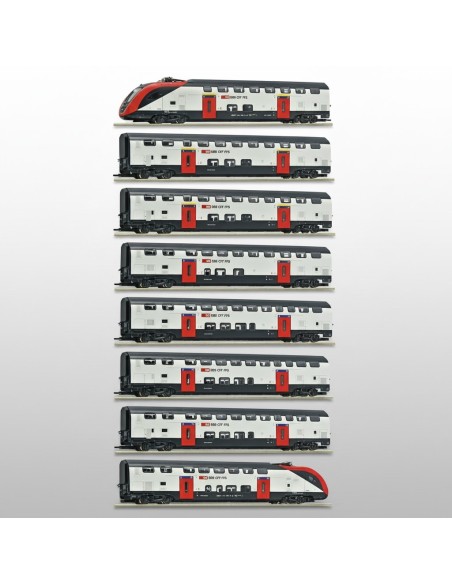
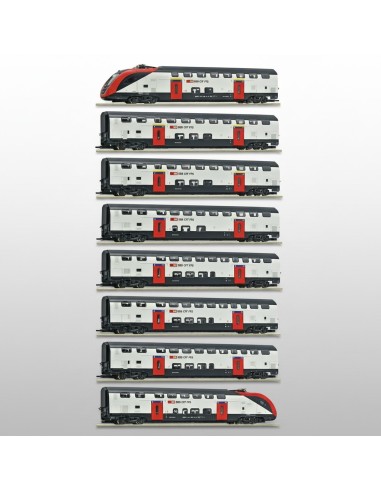
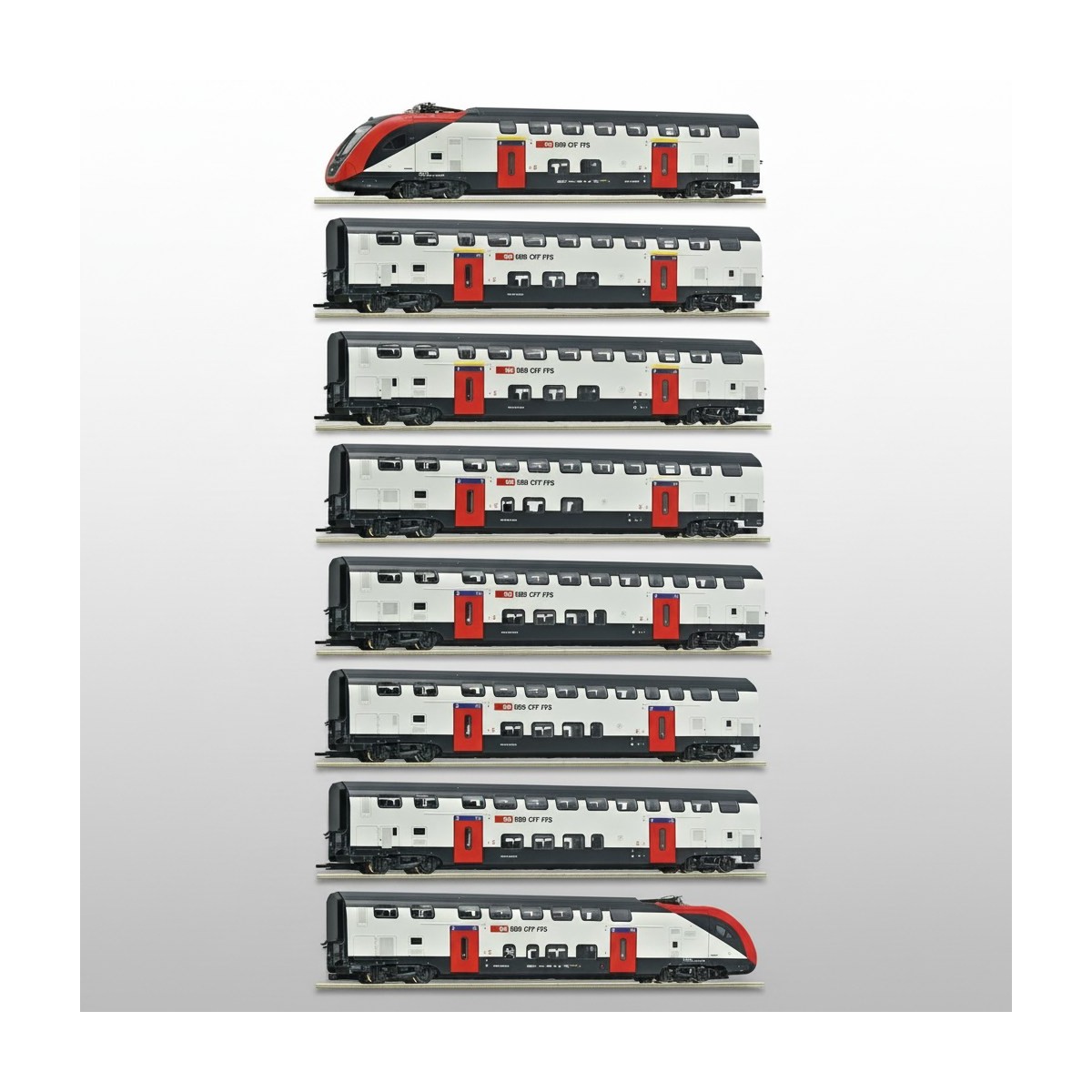
The RABe 502 is the most representative long-distance double-deck train on the SBB network today, and Roco has tackled it in 2025 as a full new-tooling project: moulds developed from scratch, current-carrying electrical couplings between all eight coaches, and an interior reproduction that distinguishes first and second class areas on both decks. The result is a 2306 mm set that reads as a coherent unit from end to end on the layout.
A complete formation ready to run
The set includes the eight coaches that make up the real Twindexx Express formation, with detailed interiors visible through flush-mounted tinted windows. The powered coach features a central flywheel motor, 4 driven axles and 4 traction tyres, ensuring smooth running even on gradients. The PluX16 interface (NEM 658) allows straightforward digital conversion: a single decoder fitted in the lead coach distributes power and signals throughout the entire consist via the functional electrical couplings linking each vehicle. LED lighting is already operational in analogue mode, with automatic switching between white front and red rear lights depending on the direction of travel.
New-tooling exterior and interior detail
The aerodynamic nose of the Twindexx, detailed pantographs on the end coaches, lateral ventilation grilles and the numerous pre-fitted individual parts roof antennas, interconnecting cables, windscreen wipers, metal handrails mean the model holds up equally well in motion and on the display shelf. The interiors reflect the actual seating layout of Swiss double-deck trains, with clearly visible class differentiation. The number reproduced is 502 221-0, corresponding to a real unit from the SBB Era VI fleet.
Layout presence and track planning
At 2306 mm long with a minimum radius of 358 mm, this set calls for careful track planning but the visual reward is proportional: over a long platform or in an interchange station scene, the eight double-deck coaches create a sense of the real train that few HO consists can match. The NEM 362 couplings with short coupling kinematics reduce the gaps between vehicles and reinforce the impression of a complete unit, something especially striking on the curves of the layout.