
Shopping Cart
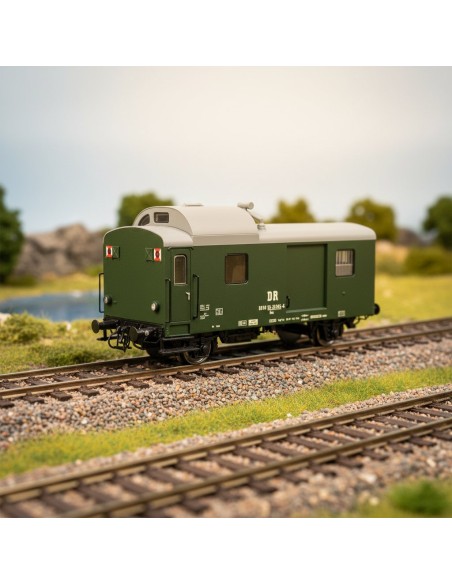
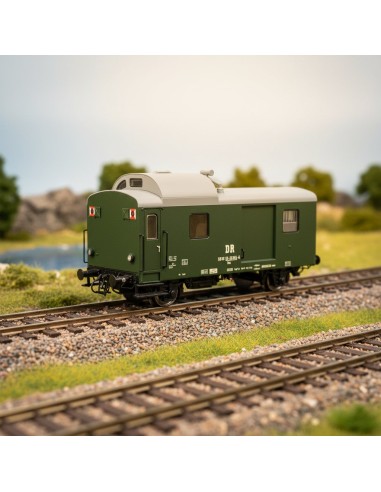
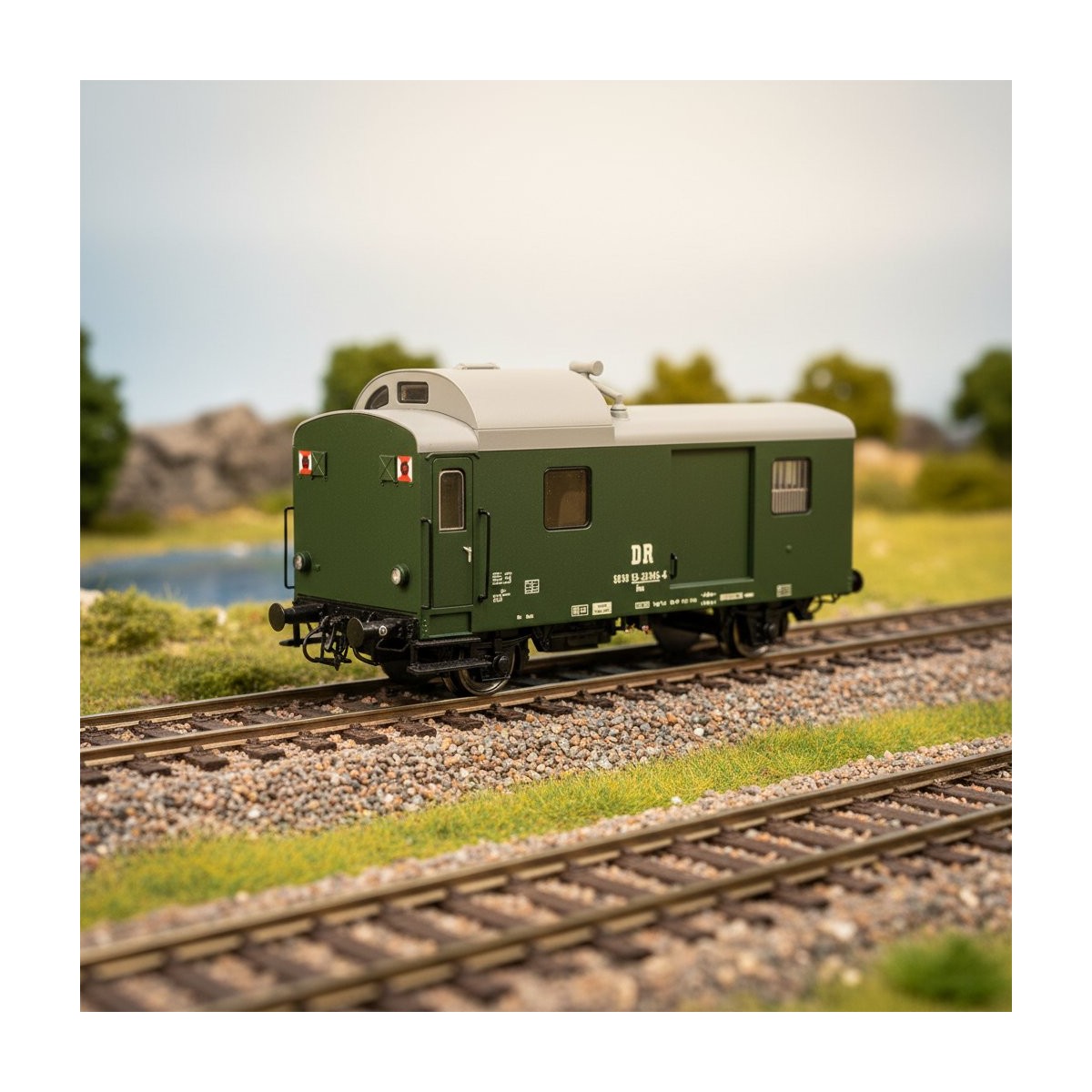
The Roco 6210176 reproduces the Gattung Daa escort van of the Deutsche Reichsbahn in HO scale, corresponding to Era IV. This is a brand-new tooling Neukonstruktion in Roco terminology that comes with a DCC On-Board decoder as standard, interior LED lighting, and red tail lights that can be switched independently from the digital controller. This is no passive wagon: it has its own electronics and draws current through pickups integrated on both axles to ensure continuous, flicker-free power.
A van with history within the DR
The Daa-type vans were built at the Waggonbau Bautzen workshops in the mid-1950s, commissioned by the DR as escort vehicles for freight trains. Their role was to shelter the train conductor and safeguard route documentation. In 1977, units that had moved into passenger luggage service were officially reclassified under the Daa designation exactly the variant reproduced by this Roco reference. The roof cupola the distinctive lantern with two transparent side windows is one of the most recognisable features of the type, and on this model it allows the interior LED light to shine through, making the working compartment visible from outside.
Tooling details and digital functions
The tooling reproduces the prototype variant without lower metal steps beneath the loading door. The sliding doors are modular and can be fitted in three different positions: fully closed, half-open, or fully open, allowing figures to be placed inside or loading operations to be simulated. The DCC On-Board decoder independently controls the interior lighting of the technical cab and the red tail signal lights (Zugschlussbeleuchtung), both in low-consumption LEDs. The NEM 362 coupler with short kinematics keeps the buffers at millimetre distance on straight track and adapts dynamically on curves.
How it fits into an Era IV freight consist
At 103 mm in length over buffers, this van takes up little space on the layout and can be integrated without difficulty at the end of a DR Era IV freight consist. Placed as the tail van, the lit red lights visually mark the end of the train and give a sense of a complete convoy that conventional unlit wagons simply cannot deliver. On a layout with night running or reduced ambient lighting, that detail completely transforms the feeling of a train in motion.