
Shopping Cart
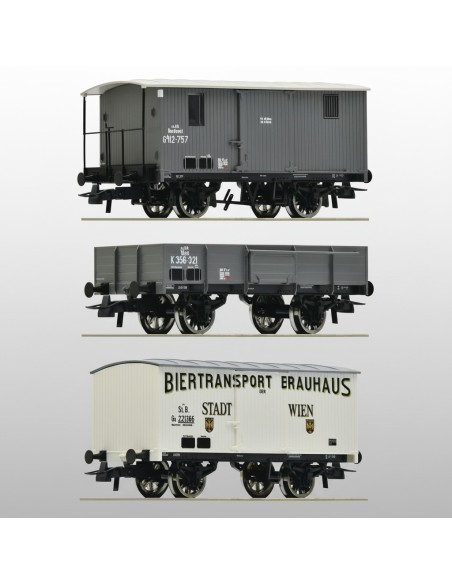
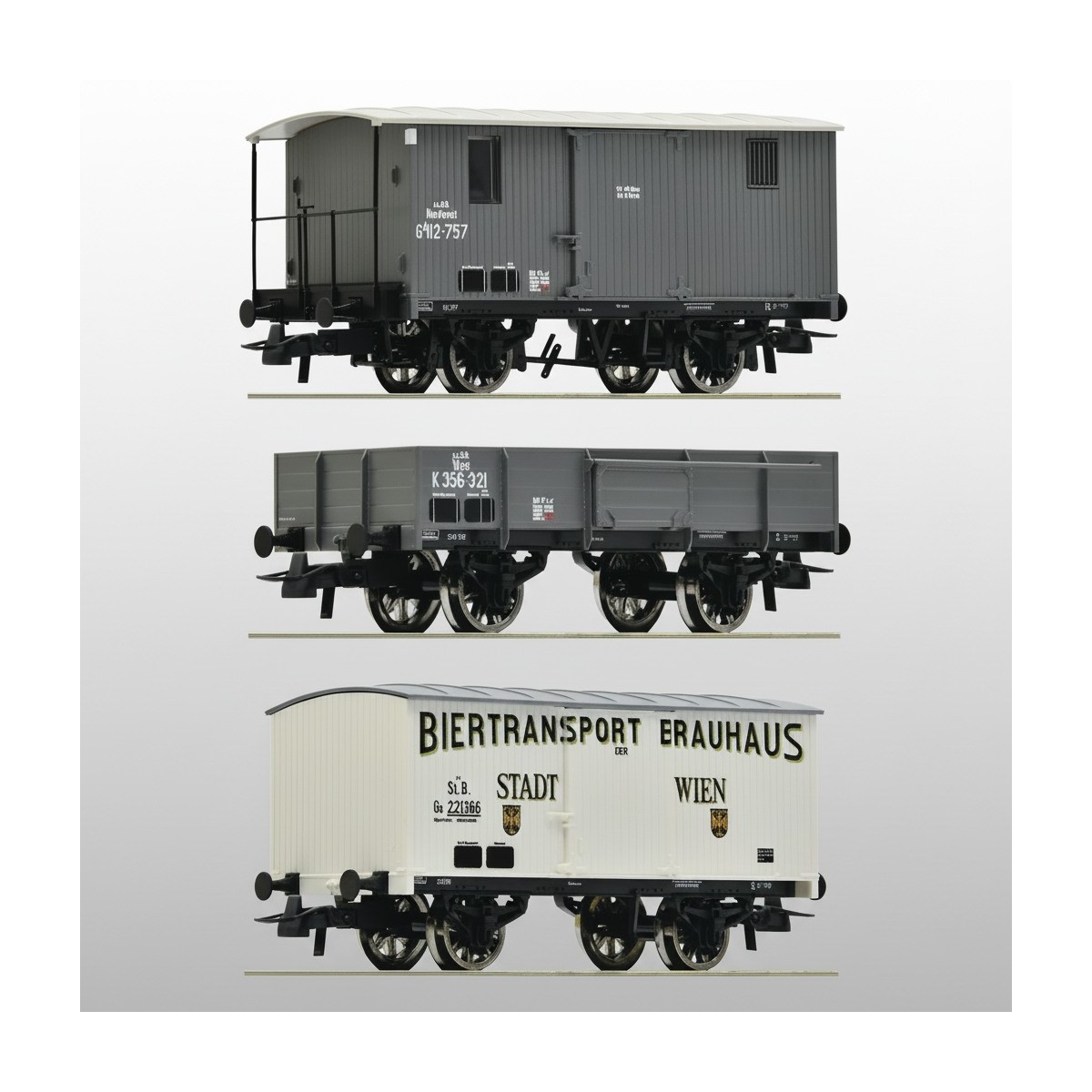
The Roco 76037 brings together three kkStB freight wagons from the Imperial Austrian State Railways in a single reference. All three toolings come from the historical archive of Klein Modellbahn, the Austrian brand absorbed by Roco, and each wagon carries pad-printed revision markings dated 1914, placing the set firmly in Era I with a level of documentary consistency rarely found in sets of this kind.
Three wagons, three roles, one Era I consist
What sets the 76037 apart from other sets is that all three wagons are entirely different from one another: the dark grey brake van (Gd 112-757) with its raised brakeman's cab and access ladder, the white/cream covered wagon (Gb 221366) with Brauhaus der Stadt Wien lettering and tongue-and-groove planking detail, and the oxide brown low-sided open wagon (West K 356-321) with side stanchions and embossed metal brackets. Together they form a consist with variety in shape, colour and function that sits naturally on an early twentieth-century layout.
Confirmed technical details
All three wagons feature fine spoked metal wheels (Speichenradsätze), characteristic of late nineteenth and early twentieth-century rolling stock, which give a very different visual reading from modern solid wheels. The coupler is a NEM 362 mechanical type with KK-Kinematik. Total coupled length of the set is 267 mm (LüP). The set is configured for two-rail DC systems; for use on Märklin three-rail track, axles must be replaced with the Roco 137185 set.
On the layout: how this set fits in
In an Era I scene, these three wagons work well behind a steam locomotive from the same operator: the variety of shapes and colours breaks the monotony of a uniform consist without losing historical coherence. The brake van, placed at the rear of the train, closes the composition visually with its raised cab as a recognisable finishing touch. For anyone modelling Austro-Hungarian or Central European themes from the early twentieth century, this set completes a local freight train in a single purchase.