
Shopping Cart
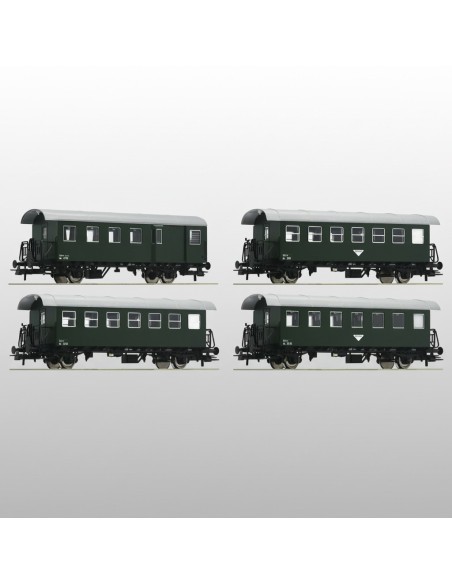
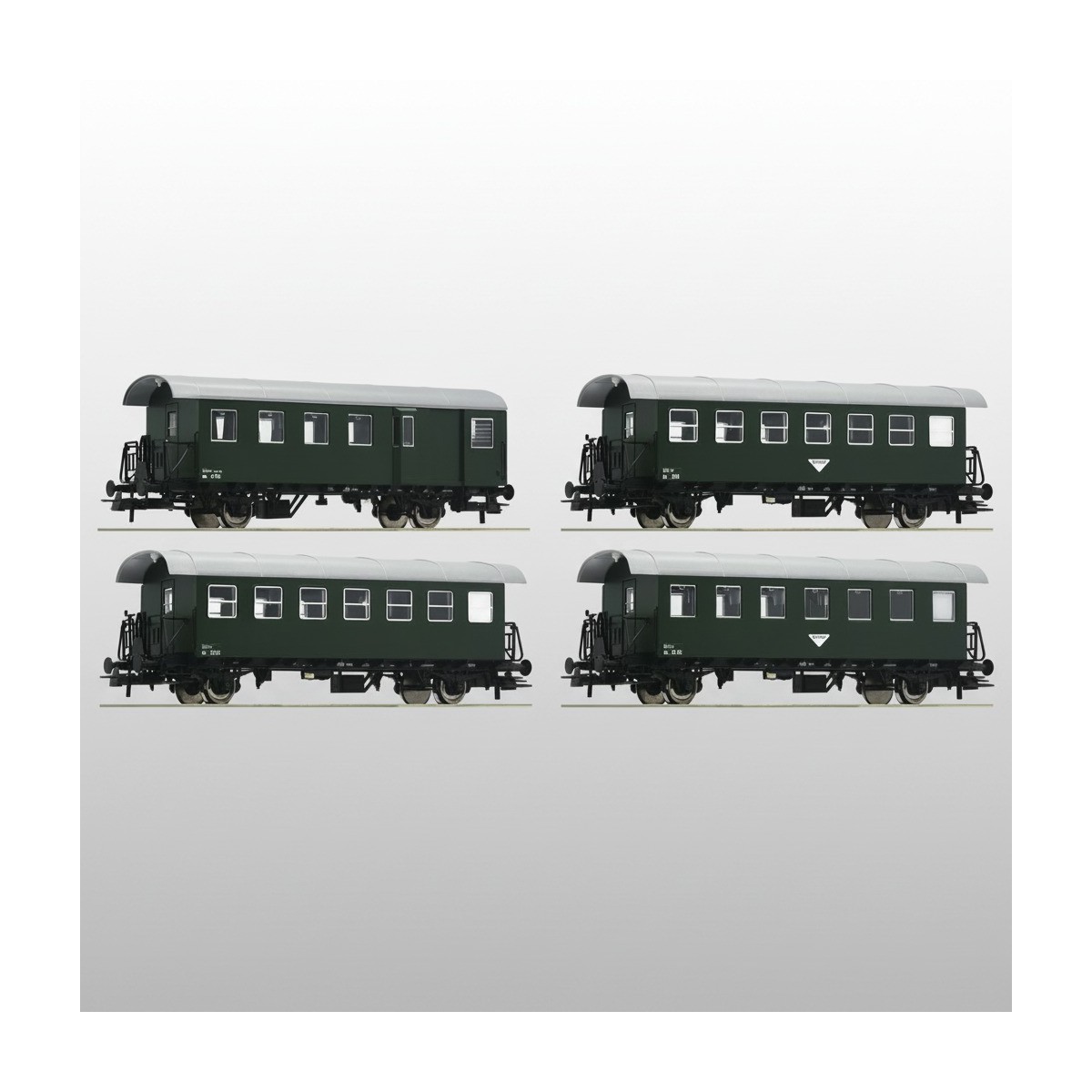
The Roco 74026 brings together four Spantenwagen passenger coaches from the ÖBB in HO scale, finished in tannengrün and assigned to the St. Valentin depot. The consist covers three variants of the Biho type two with divided windows (Halbfenstern) and one with full windows (Ganzfenstern) plus a BDiho composite brake van with a smoking compartment. All four coaches are two-axle and measure 606 mm over buffers, a length that allows them to run on layouts with relatively tight curves without losing visual coherence.
The Spantenwagen: post-war coaches with a character of their own
The Spantenwagen were born from the ÖBB's need to rebuild their passenger fleet after the Second World War. The Simmering-Graz-Pauker workshops used existing underframes and built over them a new body reinforced with steel ribs the Spanten that give the type its name creating a coach instantly recognisable by its ribbed profile. They became a familiar sight on Austrian secondary lines and suburban services throughout the 1950s to 1980s, and on the layout they remain an immediate reference for Epoch III in Austria.
Construction details and confirmed features
Roco has finished all four coaches with individually applied handrails and grab bars, fine railings on the end platforms and windows reproduced respecting the actual frame thickness at 1:87 scale. The BDiho brake van number 47561 features functional lateral sliding doors that can be opened manually, a detail that brings station loading and unloading scenes to life. The interior is detailed with seats fixed to the floor, and the set comes prepared for later LED lighting installation using the Roco 40361 kit. Couplers follow the NEM 362 standard with short coupling kinematics.
Layout integration and consist
With its four two-axle coaches, the 74026 forms a compact yet visually complete train on its own: the alternation between the divided-window Biho coaches, the full-window Biho and the composite brake van at the rear breaks the monotony of the consist without losing epoch or operator unity. In a station scene from the 1950s or 1960s, the BDiho with open doors and the uniform tannengrün of the composition place the set immediately in the context of post-war Austrian railways. For those who already have ÖBB steam locomotives in HO, this set offers coherent hauled stock to complete an Epoch III formation.