
Shopping Cart
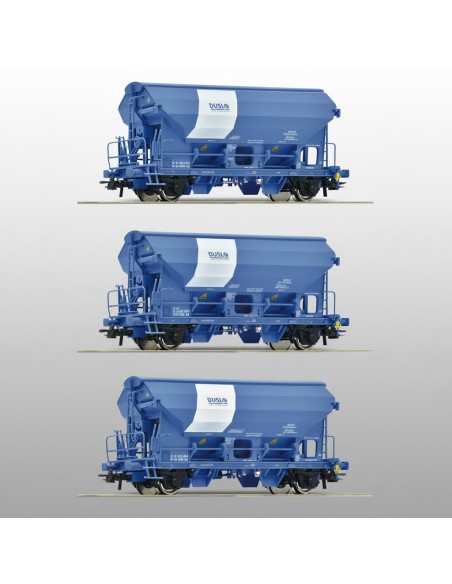
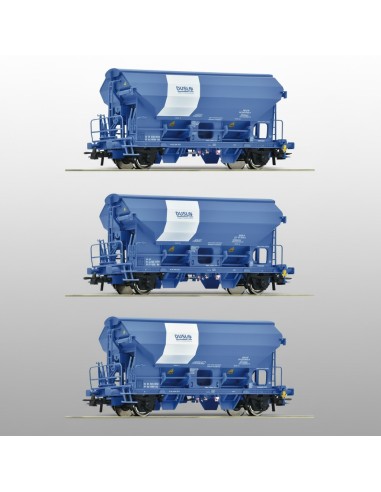
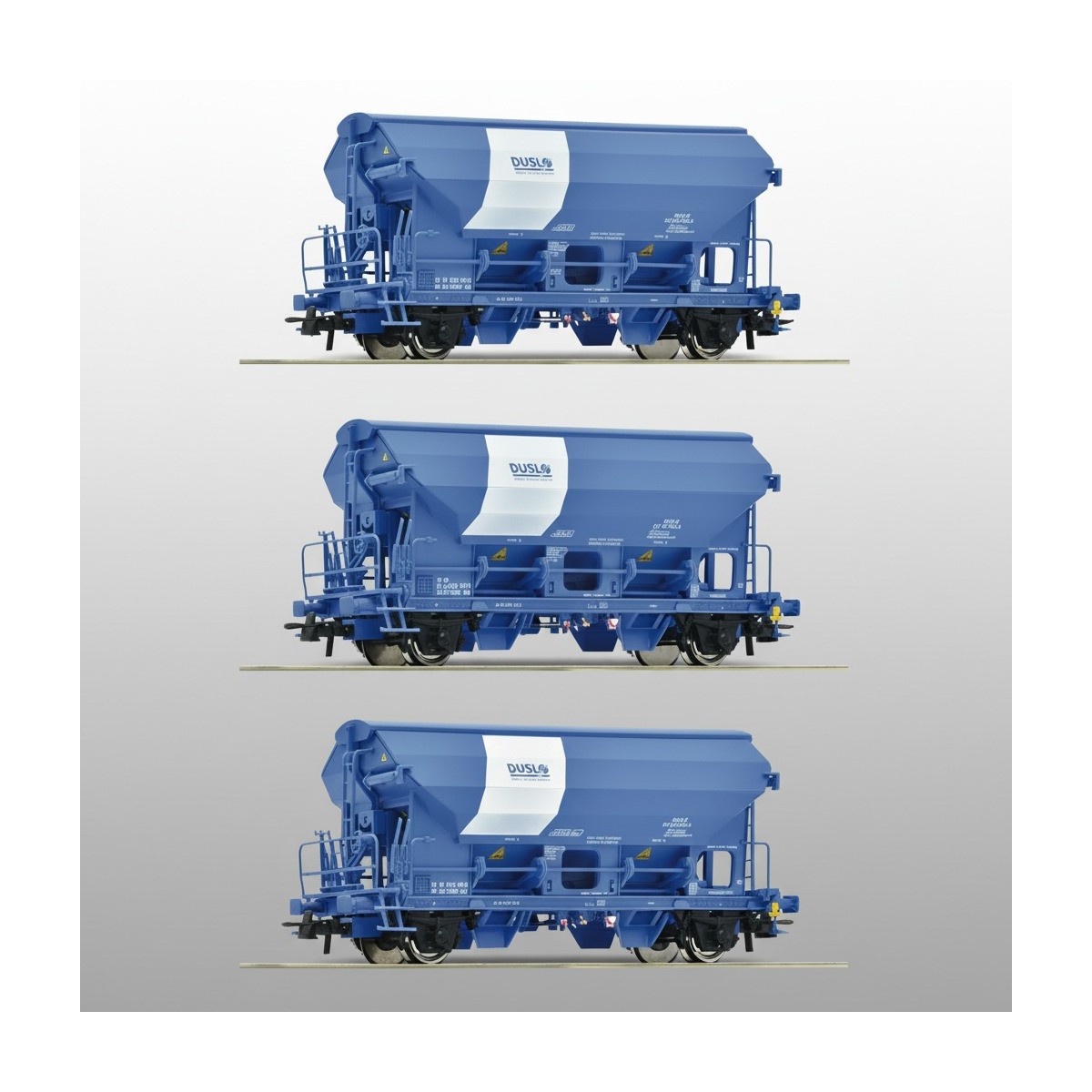
This Roco set brings together three Tdns hopper wagons with opening tilting roofs, all finished in the corporate blue livery of Duslo a.s., the Slovak chemical producer based in a?a. Each wagon carries its own individual Slovak UIC number, so all three units can share a layout without duplicating registrations a detail that makes a real difference in long freight consists.
Tdns wagons for bulk freight haulage in Epoch VI
The Tdns classification describes a two-axle wagon with a movable opening roof, gravity discharge and authorisation to run in fast freight trains. The curved roof swings laterally to allow loading from industrial silos, then closes to protect the contents from rain particularly relevant for the granulated fertilisers and bulk chemical compounds that Duslo handles in real-world operations. On the layout, the three coupled wagons add up to 333 mm in total length, enough to give body to a block freight train without demanding too much track space.
Construction detail and track behaviour
The moulding includes end walkway platforms, freestanding access ladders and a reproduction of the lateral mechanical linkages that operate the roof tipping mechanism. The short NEM 362 couplers with KK-Kulisse kinematics keep the buffers almost in contact on straight track and separate just enough through curves, giving the consist a very compact visual read. Polished metal wheels with NEM profile ensure smooth running on DC two-rail systems; to run on Märklin three-rail layouts, replacement with Roco AC axles 40196 is required. The minimum radius of 358 mm allows the set to negotiate industrial sidings and tight curves without compromising operation.
Integration into a consist and layout scene
On an Epoch VI layout featuring industrial facilities or loading terminals, these three wagons work well as the core of a block freight train that can be extended with additional units of the same type. The uniform livery and differentiated registrations reinforce the visual coherence of the consist, and the tilting roof adds an operational point of interest that goes beyond aesthetics: in a loading scene alongside a silo or industrial shed, the lateral mechanism detail is visible and recognisable even at scale.