
Shopping Cart
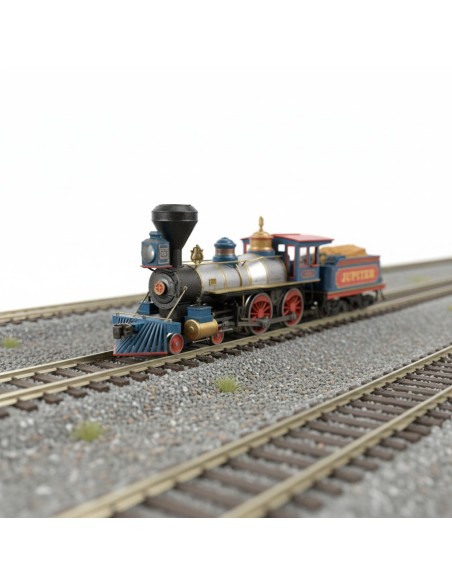
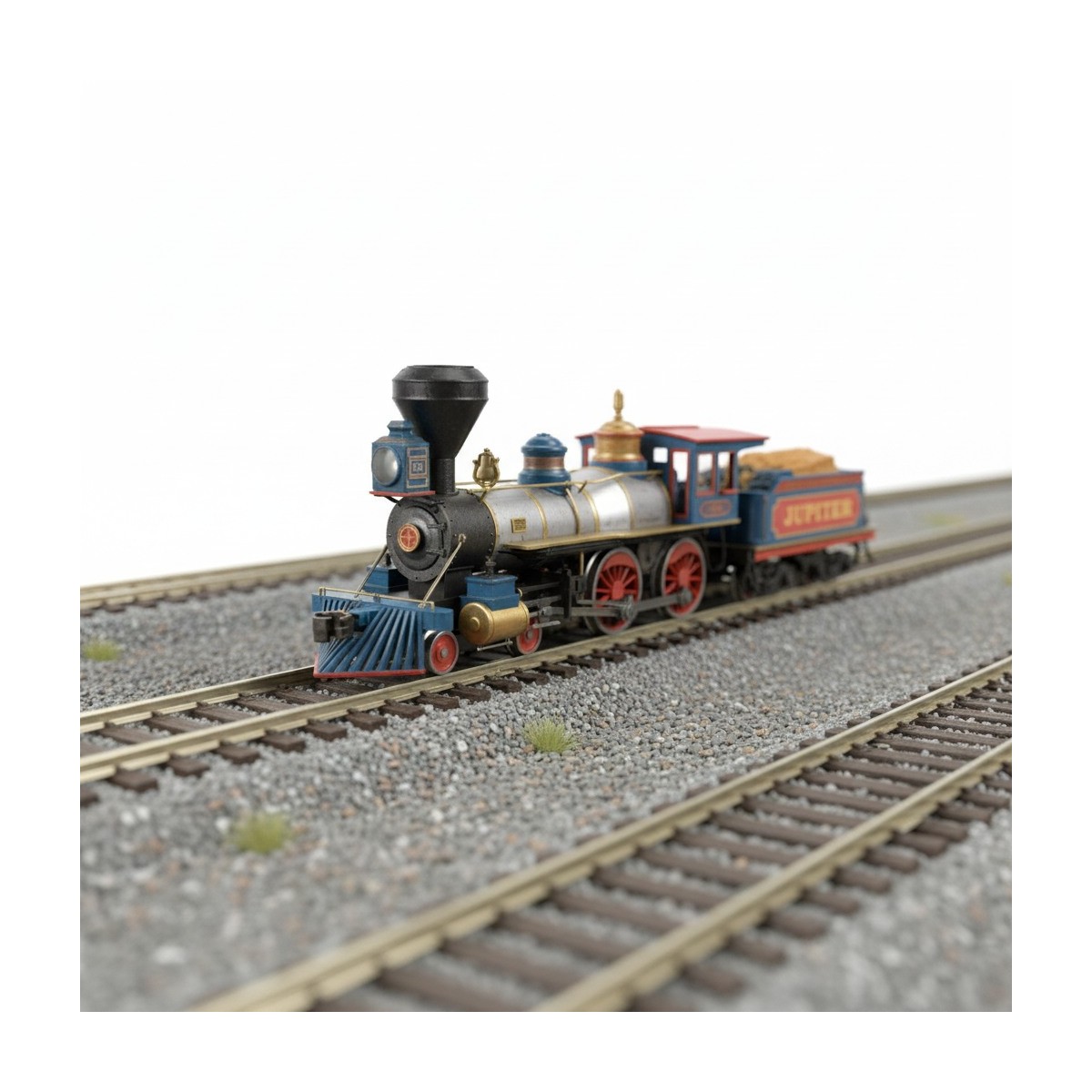
Some locomotives belong to the catalogue. Others belong to history. The Central Pacific #60 Jupiter clearly falls into the second category. Bachmann presents it under reference 52702 in its HO range, with a DCC Sound Value decoder and Soundtraxx Econami sound, offering a version of this American railway icon ready to run on a digital layout or conventional analogue track.
The Jupiter at Promontory Summit
On 10 May 1869, at Promontory Summit, Utah, the Central Pacific's Jupiter and the Union Pacific's No. 119 met face to face to mark the completion of the first transcontinental railroad in North America. That moment, known as the Golden Spike ceremony, made both locomotives permanent landmarks in United States railway history. The Jupiter carried Central Pacific president Leland Stanford to the meeting point that day. Bachmann reproduces that historic livery royal blue, red, gold and metallic details complete with the characteristic balloon stack chimney, designed to retain sparks from wood combustion, which the tender carries as its load.
Confirmed technical specification
The 52702 features a dual-mode NMRA DCC Sound Value decoder with Soundtraxx Hyperdrive2 motor control and Flex-Map function mapping from F0 to F28. The 16-bit Soundtraxx Econami sound includes synchronised chuff, short and long whistles, bell, air pump and steam release. Front lighting is warm LED with an oil-lamp flicker effect. The chassis is die-cast, with RP25-profile metal wheels, die-cast scale spokes and metal connecting rods. Handrails and sand lines are separately applied. The cab features a detailed interior with clear windows. Couplers are E-Z Mate Mark II magnetic. Overall length of locomotive and tender combined is 190 mm, and the minimum recommended radius for smooth running is 38 cm (15 inches).
On the layout: visual weight and historical reference
A 4-4-0 American of these proportions fills the head of a period consist with authority. The Jupiter's livery vivid colours and the balloon stack dominating the profile draws the eye from the very first stretch of track. In a scene set in the nineteenth-century American West, leading a string of wooden or open freight wagons, the railway reading is immediate: no additional context is needed to understand the era and territory the train represents. For those who want to recreate that specific moment from 1869, placing the Jupiter opposite the Union Pacific No. 119 also available in the Bachmann catalogue turns the layout into a direct recreation of Promontory Summit.